
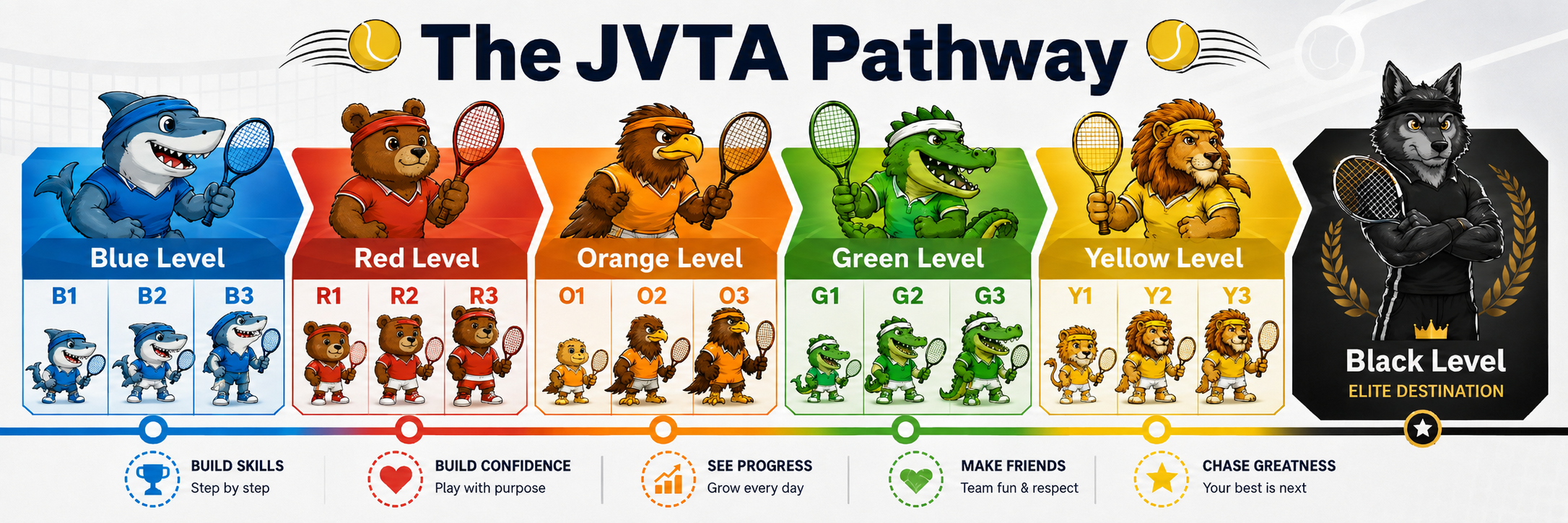
JVTA Player Pathway
The JVTA Player Pathway gives every player and parent a clear roadmap for tennis development — showing where a player is now, what they need to improve, and what is required to progress.
How the Pathway Works
Players progress through six levels:
Blue → Red → Orange → Green → Yellow → Black
Most levels are divided into three stages, for example:
Orange 1 → Orange 2 → Orange 3 → Green 1
Players are assessed continuously by their coaches during normal lessons, so there are no formal assessment days.
Progress is measured across five areas:
Technical Skills
Physical Development
Tactics & Tennis IQ
Mental & Character
Participation & Competition
A player graduates once they have demonstrated the required competencies across their stage.
How Long Does Each Stage Take?
Players will generally spend a minimum of around two terms in each stage.
Progress is not based purely on strokes. A player may be technically strong but still need to develop areas such as decision-making, movement, resilience, match play or focus before graduating.
Every player develops at a different pace depending on their age, experience and how often they play.
Graduation Week
We want progression to feel exciting and rewarding.
When a player graduates to a new stage, they receive a custom JVTA racket dampener featuring their level mascot.
When a player progresses into a new colour level, they also receive a new racket grip, fitted by their coach.
Our mascots are:
Blue – Shark | Red – Bear | Orange – Eagle | Green – Crocodile | Yellow – Lion | Black – Wolf
A $5 graduation fee is added to your invoice when your child progresses to a new stage or level. This covers their custom dampener or grip.
Age Groups vs Pathway Stages
Lesson groups remain primarily age-based in line with Tennis Australia Hot Shots guidelines:
Blue: 3–5 | Red: 5–7 | Orange: 8–10 | Green: 10–12 | Yellow: 12+
The Player Pathway itself is competency-based.
This means two children in the same lesson may be at different Pathway stages depending on their experience, development and amount of practice.
If your child reaches a new age bracket during the term, we generally allow a six-month transition period and consider their ability, confidence, physical readiness and available places before moving them into a new lesson group.
The Goal
The Pathway is not about racing through levels.
It is designed to give players clarity, confidence, motivation and a sense of achievement while helping parents better understand their child's development.